
Hyundai Motor India Ltd reported a 35 per cent decline in consolidated profit after tax to Rs 888.62 crore in the first quarter ended June 30, impacted by lower revenue and higher expenses, with MD & CEO Tarun Garg noting it was a "challenging quarter".

Hyundai Motor India Ltd reported a 22.22 per cent decline in consolidated profit after tax to Rs 1,255.63 crore in the March quarter, primarily due to higher expenses, despite an increase in total revenue from operations.

Hyundai Motor India Ltd, the Indian arm of South Korean automaker Hyundai, has received capital markets regulator Sebi's approval to float an initial public offering (IPO), people familiar with the development said on Wednesday. This development marks a significant milestone for the Indian industry, as it is the first automaker initial share-sale in over two decades, following Japanese automaker Maruti Suzuki's listing in 2003.

Hyundai Motor India Ltd (HMIL) is set to launch a localised mass-market SUV built on a dedicated EV platform, expanding its EV portfolio beyond the IONIQ 5 and CRETA Electric, while also significantly boosting its charging infrastructure and training its workforce.

Hyundai Motor India Ltd on Thursday reported a 14.3 per cent rise in consolidated net profit to Rs 1,572.26 crore in the second quarter ended September 30, 2025.


In August, Hyundai recorded its highest ever domestic sales for the month with 54,396 units sold, marking a 23.6 per cent Y-o-Y increase. The Creta Electric currently anchors Hyundai's mass-market electric portfolio, while the Ioniq 5 caters to the premium end

South Korean auto major Hyundai Motor Co president & CEO Jose Munoz on Wednesday said the company's Indian arm will invest Rs 45,000 crore by FY30, aiming to make India its second-largest region globally. Addressing investors here in his first visit to the country, Munoz said Hyundai Motor India Ltd (HMIL) has set a target of up to 30 per cent export contribution.

For FY26, the company has adopted a cautious outlook, anticipating domestic growth to broadly track the industry's low single-digit estimated growth amid ongoing economic headwinds.
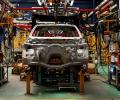
Passenger vehicle dispatches in the domestic Indian market are estimated to have surged by 33 per cent to approximately 4.7 lakh units in July, with market leaders Maruti Suzuki and Hyundai reporting record sales, alongside significant growth from Tata Motors and Mahindra & Mahindra.

Hyundai Motor India (HMIL) raised Rs 8,315 crore from anchor investors on Monday, setting the stage for the country's biggest-ever maiden share sale. The Indian arm of the South Korean carmaker Hyundai Motor Company (HMC) allotted 42.4 million shares to 225 funds at Rs 1,960 apiece, the higher end of its price band. Among the investors receiving allotments were the Singapore government's sovereign wealth fund (GIC), New World Fund, and Fidelity.
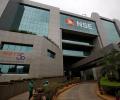
The National Stock Exchange (NSE) has set its initial public offering (IPO) price band at Rs 1,700-1,785 per equity share, with the subscription period running from September 17 to September 21, aiming to raise up to Rs 22,569 crore.

Hyundai Motor India Ltd (HMIL) announced plans to make Tamil Nadu its 'flagship EV hub for India', committing over 26,000 crore in investment, enhancing localisation, and creating approximately 2,000 additional jobs over the next five to six years. The company will roll out two new EV models from its Chennai facility this year, including its first mass-market dedicated EV.

India's passenger vehicle sales are estimated to have surged by approximately 35 per cent to about 4.5 lakh units in August, driven by strong performances from major automakers like Maruti Suzuki India, Tata Motors Passenger Vehicles, and Mahindra & Mahindra, with the industry entering the festive season with optimism.

The partnership strengthens HMC's presence in global cricket, marking its return to the sport after its earlier association with the ICC between 2011 and 2015.

Leading automakers in India, including Maruti Suzuki, Tata Motors, Mahindra & Mahindra, and Hyundai, reported increased vehicle dispatches to dealers in February, driven by sustained domestic demand.
Leading automakers in India, including Maruti Suzuki, Tata Motors, Mahindra & Mahindra, and Hyundai, reported increased vehicle dispatches to dealers in February, driven by sustained domestic demand.

The National Stock Exchange's (NSE) initial public offering (IPO) is expected to shrink in size to Rs 25,000-27,000 crore, down from an earlier estimate of Rs 30,000 crore, as some shareholders are reducing their offer for sale (OFS) stake.

Hyundai has started to build one of two new factories planned for China.

The company has not indicated the exact rise in prices of its models

Tata Motors has emerged as the biggest market-share gainer among India's leading passenger vehicle (PV) makers in the first eight months of 2026, securing the No. 2 position in the PV market.
Danish brewing giant Carlsberg has confidentially filed draft papers with India's markets regulator Sebi for an initial public offering (IPO) of its Indian business, joining a growing list of multinational companies looking to tap India's equity markets.

Long standing number two passenger vehicle maker in India, Hyundai Motor India, has slipped to fourth position in the domestic market in terms of retail sales last month behind Maruti Suzuki India, Mahindra & Mahindra and Tata Motors, as per the latest data shared by dealer's body FADA. Hyundai Motor India clocked retail sales of 38,156 units last month, a dip of 20 per cent as compared with 47,540 units in February last year.

The National Stock Exchange (NSE) is set to launch India's largest initial public offering (IPO), estimated at Rs 30,000 crore. This mega public issue will surpass previous records held by Hyundai Motor India and Life Insurance Corporation of India (LIC), marking a significant event in the Indian stock market. The move comes as India's primary market shows signs of recovery after a period of slowdown.

Tata Motors expands its market leadership in India's electric passenger vehicle (ePV) segment, capturing 39 per cent of the market in Q1FY27, while simultaneously strengthening its position as the nation's second-largest carmaker amidst fierce competition and rapid market growth.

Hyundai Motor India Ltd has become the country's fifth most valuable auto firm by market valuation in its debut trade on Tuesday. Shares of Hyundai Motor India Ltd, the Indian arm of South Korean automaker Hyundai, listed at Rs 1,931, reflecting a decline of 1.47 per cent against the issue price of Rs 1,960 on the BSE earlier in the day. The stock slumped 7.80 per cent to Rs 1,807.05 during the day and finally ended at Rs 1,820.40 apiece, down 7.12 per cent.

The automaker was found to have engaged in anti-competitive practices.
The National Stock Exchange of India Ltd (NSE) has received regulatory approval from SEBI for its long-awaited Rs 30,000-crore initial public offering (IPO), positioning it to potentially become the country's largest-ever public issue.
The National Stock Exchange (NSE) is reportedly planning to launch its much-anticipated initial public offering (IPO), estimated at around Rs 30,000 crore, in September, potentially valuing the exchange at over Rs 5 lakh crore.

Hyundai Motor India on Wednesday said the company is not facing any production issues due to the shortage of rare earth magnets. Replying to a query in the company's earnings conference call, Hyundai Motor India head of investor relations K S Hariharan noted that the company is maintaining an adequate inventory of the rare earth magnets.

Post the launch of 'Grand' in the Indian market, Hyundai has experienced a 55 per cent rise in footfalls at dealerships across all regions and most dealerships are recording multiple enquires and test drive requests, it added.

Indian passenger vehicle manufacturers are significantly increasing production and stocking dealerships in anticipation of strong festival season demand, with new launches planned and supply bottlenecks being addressed. However, the industry faces potential moderation in growth during the second half of FY27 due to a high base from last year's post-GST surge, commodity inflation, and elevated inventory levels.
South Korean automaker Hyundai Motor Company on Tuesday exited Ola Electric Mobility by selling its entire 2.47 per cent stake in the company for Rs 552 crore through an open market transaction. According to the bulk deal data available on the NSE, Hyundai Motor Company sold more than 10.88 crore shares or 2.47 per cent stake in Bengaluru-based Ola Electric Mobility.

The petrol versions of the car are priced between Rs 5,05,000 and Rs 6,66,000.

Shares of Hyundai Motor India Ltd, the Indian arm of South Korean automaker Hyundai, on Tuesday made a muted market debut and further fell by nearly 6 per cent against the issue price of Rs 1,960. The stock listed at Rs 1,931, reflecting a decline of 1.47 per cent from the issue price on the BSE. Later, the stock made some recovery and hit a high of Rs 1,968.80, up 0.44 per cent.

The initial public offer of Hyundai Motor India Ltd, the Indian arm of South Korean automaker Hyundai, got subscribed 2.37 times on the third day of the bidding on Thursday, helped by institutional buyers. This is the largest IPO in the country, surpassing LIC's initial share sale of Rs 21,000 crore. The Rs 27,870 crore initial share sale got bids for 23,63,26,937 shares against 9,97,69,810 shares on offer, translating into 2.37 times subscription, as per NSE data.
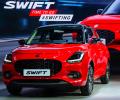
Passenger vehicle sales in India are estimated to have surged by nearly 25 per cent in June 2024, reaching approximately 4 lakh units, with Maruti Suzuki, Tata Motors PV, and Mahindra & Mahindra leading the growth, despite concerns over geopolitical tensions and monsoon impact.

The initial public offer of Hyundai Motor India Ltd, the Indian arm of South Korean automaker Hyundai, received an 18 per cent subscription on the first day of bidding on Tuesday. The Rs 27,870 crore initial share sale received bids for 1,77,89,457 shares against 9,97,69,810 shares on offer, as per NSE data. The IPO received over 9 lakh applications on the first day.
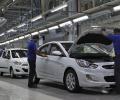
Indian carmakers experienced a robust start to the new fiscal year, with an estimated 4.5 lakh passenger vehicles sold in April, marking a 27 per cent increase year-on-year, attributed to factors like GST 2.0, repo rate cuts, and income tax benefits.
Lining up its 2030 strategy, Hyundai said it was targeting up to 30 per cent export contribution and over 1.5-fold rise in revenue, to cross the 1 trillion milestone in five years.
